Diffusion-based text-to-motion models synthesize realistic human motions but often exhibit semantic
drift from the input text. Motion is inherently temporal, especially in compositional and long-duration
sequences that require semantic consistency across multiple action segments and smooth kinematic
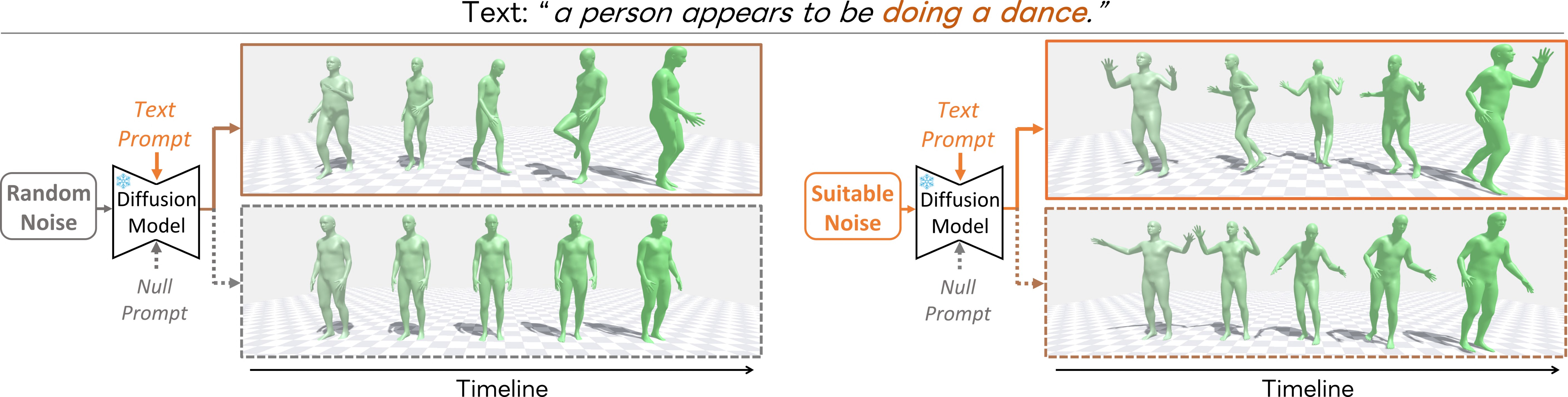
transitions throughout the trajectory. We posit that the initial noise is central to this consistency:
within the Gaussian noise space, certain instances, i.e. winning noise tickets, carry latent
structure that biases denoising toward particular motion semantics, even under null prompts.
We propose WInning Noise Retrieval and
Optimization (WINRO), a training-free, model-agnostic framework that
improves text-motion alignment by selecting and refining such tickets before diffusion sampling.
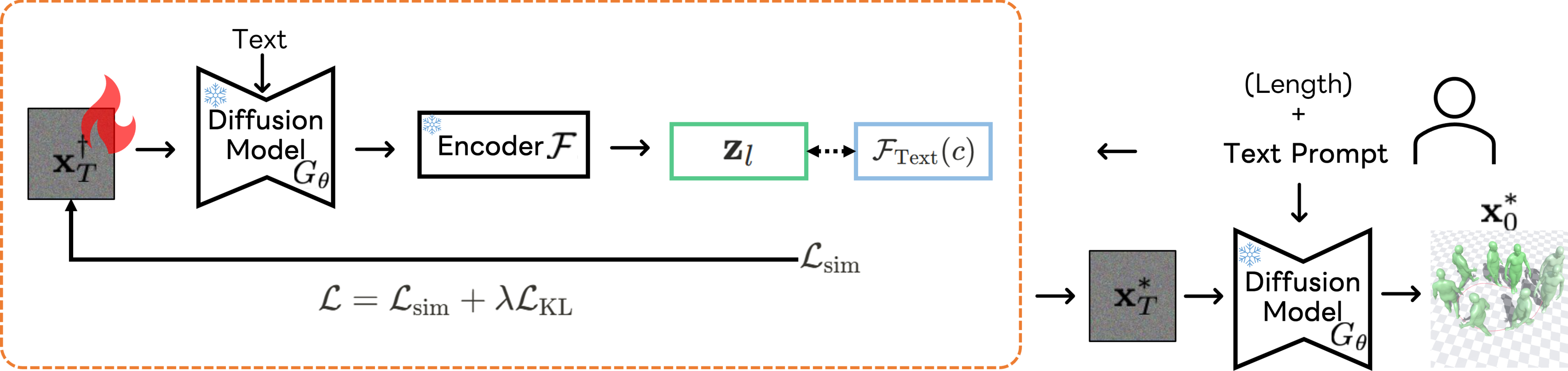
WINRO maps random noises to motion features generated under null prompts, retrieves the best-aligned
noise for a given text, and refines it via a KL-regularized objective that reduces the residual semantic
gap while preserving the Gaussian prior. An optional LoRA-based adapter amortizes this refinement into a
single forward pass.
WINRO consistently improves text-motion fidelity across different base models, MDM and MotionLCM,
on HumanML3D without retraining, improves temporal robustness on the MTT benchmark, and generalizes to
applications such as motion stylization and spatial constraint satisfaction.